Xander Reed · 23 October 2026
Ancient Volcanic Channels as Natural Labs: Linking Trace Element Maps with Coordinated Multi-Nation Plant Trials Near the Lunar South Pole
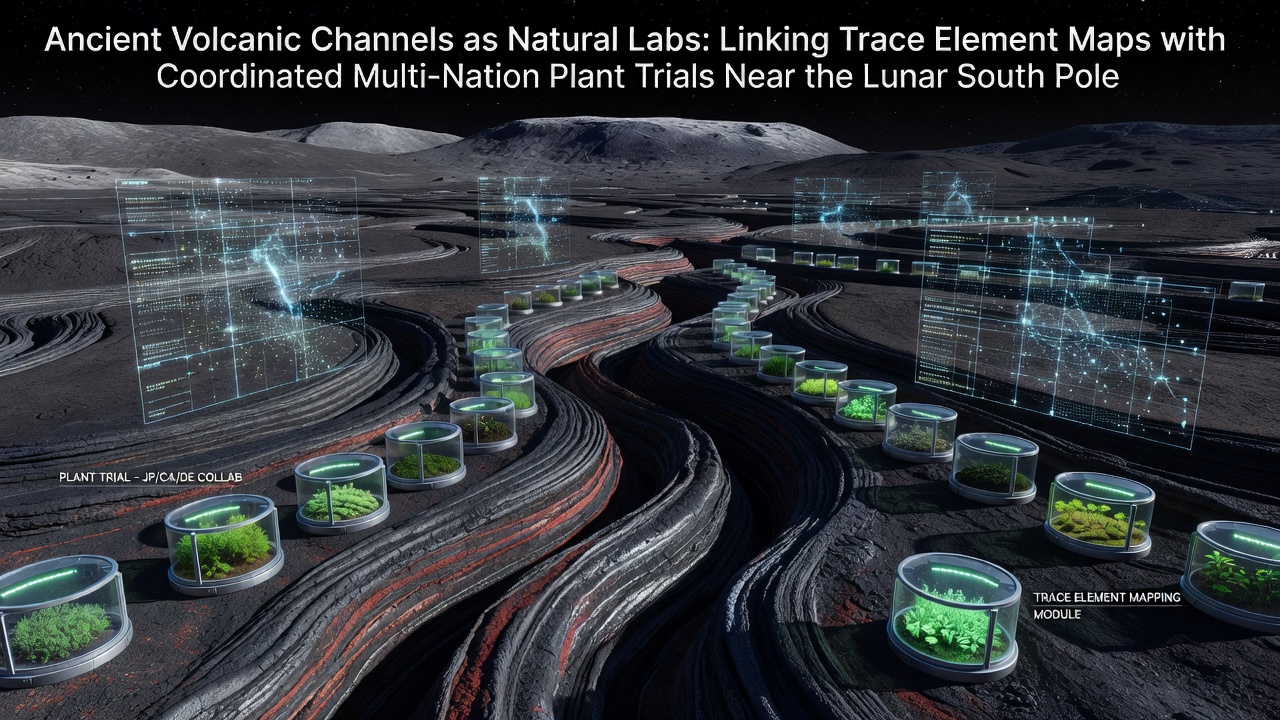
Ancient volcanic channels on the Moon have drawn sustained attention from international research teams because these formations preserve layered regolith that records volcanic history while offering sheltered microenvironments for controlled experiments. Data from orbital spectrometers and rover traverses show that many channels near the lunar south pole contain distinct trace element signatures including elevated levels of titanium, chromium, and rare earth elements that vary systematically along channel walls and floors. Researchers have mapped these patterns using instruments on recent missions and have begun to correlate them with plant growth responses in shielded test beds established within the same formations.
Geological Context and Trace Element Distribution
Volcanic channels formed during the Imbrian period created sinuous rilles and collapsed tube segments that now function as natural laboratories because their walls expose vertical sequences of basalt and pyroclastic deposits without requiring extensive excavation. Studies conducted by teams from multiple space agencies indicate that trace element concentrations shift measurably over distances of tens of meters, with certain segments enriched in potassium and phosphorus while adjacent zones show higher concentrations of incompatible elements such as zirconium and niobium. These gradients allow experimenters to place plant growth modules at sites with known geochemical baselines and to track how nutrient uptake changes when seeds germinate in regolith that has been minimally altered by surface processes.
Coordinated mapping efforts have produced high-resolution trace element overlays that integrate data from gamma-ray spectrometers and laser-induced breakdown spectroscopy units deployed on both orbiting platforms and surface assets. One study revealed that channels located within 5 degrees of the south pole retain volatile compounds in shadowed alcoves, creating localized zones where water ice and trace metals coexist in measurable quantities. This combination has prompted plant biologists to test whether selected crop species can extract and concentrate specific elements while maintaining viability under reduced gravity and elevated radiation levels.
Multi-Nation Plant Trial Coordination
Plant trials near the lunar south pole now operate under formal agreements among agencies from the United States, Europe, Japan, Canada, and Australia, with each partner contributing specialized instrumentation or seed varieties. Growth chambers placed inside channel segments receive power from nearby solar arrays and telemetry links routed through relay satellites positioned at stable Lagrange points. Data streams from these chambers transmit daily measurements of biomass accumulation, photosynthetic efficiency, and elemental uptake rates directly to ground control centers where joint analysis teams compare results against control samples grown in Earth-based regolith simulants.
Experiments scheduled through late 2026 include synchronized planting cycles timed to coincide with the October 2026 International Lunar Science Conference, during which preliminary results will be presented to participating investigators. Seed stocks selected for these trials include drought-tolerant wheat lines developed at Canadian research stations, nitrogen-fixing legumes studied at European agricultural institutes, and salt-tolerant rice varieties tested at Australian facilities. Each variety undergoes parallel cultivation in regolith collected from channels with differing trace element profiles so that uptake patterns can be compared across geochemical gradients.
Linking Maps to Experimental Outcomes
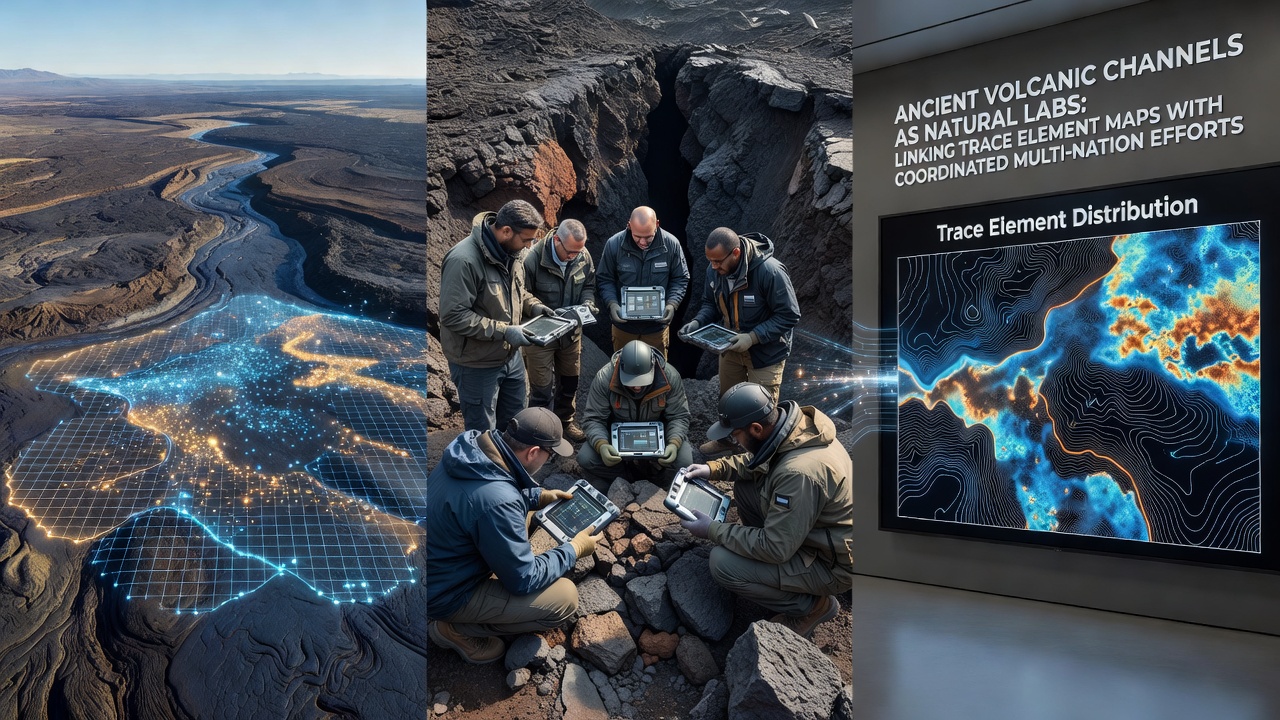
Trace element maps generated from orbital and surface measurements now serve as predictive layers that guide placement of individual growth modules. Teams position chambers containing high-phosphorus regolith at sites previously flagged by spectrometer data, then monitor whether plants exhibit accelerated root development or altered metal accumulation in edible tissues. Early telemetry indicates that certain legume varieties concentrate chromium at rates consistent with predictions derived from the maps, while wheat lines show reduced uptake of zirconium when grown in zones mapped as depleted in that element. These correlations strengthen the case for using ancient volcanic channels as standardized test environments where geochemical variability can be treated as an experimental variable rather than an uncontrolled factor.
Communication protocols among the partner agencies require that all raw spectrometer readings and plant performance logs be deposited in a shared repository hosted by the European Space Agency within 48 hours of collection. Analysts at participating institutions then apply common statistical frameworks to identify statistically significant links between specific trace element thresholds and measurable changes in plant physiology. The approach reduces duplication of effort and allows rapid adjustment of subsequent trial parameters when unexpected elemental interactions appear.
Operational Considerations for Future Campaigns
Logistical planning for expanded trials in 2026 and beyond incorporates lessons from initial deployments, particularly the need for redundant thermal control systems that maintain stable temperatures inside channel segments where diurnal swings remain pronounced even in permanently shadowed areas. Power budgets now allocate dedicated capacity for LED arrays tuned to photosynthetic absorption peaks, while communications redundancy relies on cross-linked surface nodes that relay data to orbital assets operated jointly by NASA and JAXA. These measures support continuous monitoring across multiple lunar day-night cycles and allow researchers to capture cumulative effects of radiation exposure on both regolith chemistry and plant metabolism.
Conclusion
Ancient volcanic channels near the lunar south pole have become focal points for integrated research that connects detailed trace element mapping with coordinated plant growth experiments conducted by multiple nations. The systematic placement of growth modules within geochemically characterized sites has produced measurable correlations between regolith composition and plant performance, while shared data protocols ensure that findings remain accessible across participating agencies. As additional trials proceed through October 2026 and subsequent cycles, the accumulated datasets are expected to refine strategies for sustaining plant-based life support systems in similar lunar environments.