
Devon Patterson · 25 September 2026
How Global Teams Are Refining Predictions of Moon Dust Movement to Enhance Multi-Vehicle Exploration Campaigns
Researchers from multiple space agencies have intensified efforts to model lunar dust dynamics as preparations advance for coordinated vehicle fleets on the Moon, and data from recent orbital observations combined with ground simulations continue to sharpen those forecasts. Teams track how electrostatic forces and mechanical disturbances lift and transport regolith particles across the surface, since even minor miscalculations can affect navigation systems and equipment longevity during extended campaigns.
Current Challenges in Lunar Regolith Behavior
Particles on the lunar surface carry electrostatic charges that respond to solar radiation and vehicle movement, while finer grains tend to adhere to surfaces and travel farther than earlier models predicted. International groups compile datasets from rover wheels, lander plumes, and micrometeorite impacts to update particle trajectory algorithms, and these refinements help predict how dust clouds might obscure sensors or settle on solar panels during simultaneous operations by several vehicles.
Global coordination relies on shared simulation platforms that incorporate variables such as terrain slope, vehicle speed, and solar angle, because isolated national models often diverge when applied to fleet-scale scenarios. In September 2026, updated particle interaction parameters derived from cross-agency field tests entered public repositories, allowing independent teams to validate their forecasts against standardized benchmarks.
Techniques Driving Improved Forecasts
Computational fluid dynamics adapted for vacuum conditions now integrate discrete element methods that simulate billions of individual grains, and researchers couple these outputs with real-time telemetry from surface assets to calibrate predictions dynamically. Laboratory chambers on Earth replicate lunar gravity and vacuum to test scaled rover prototypes, while high-speed imaging captures ejection angles and velocities that feed directly into the global databases.
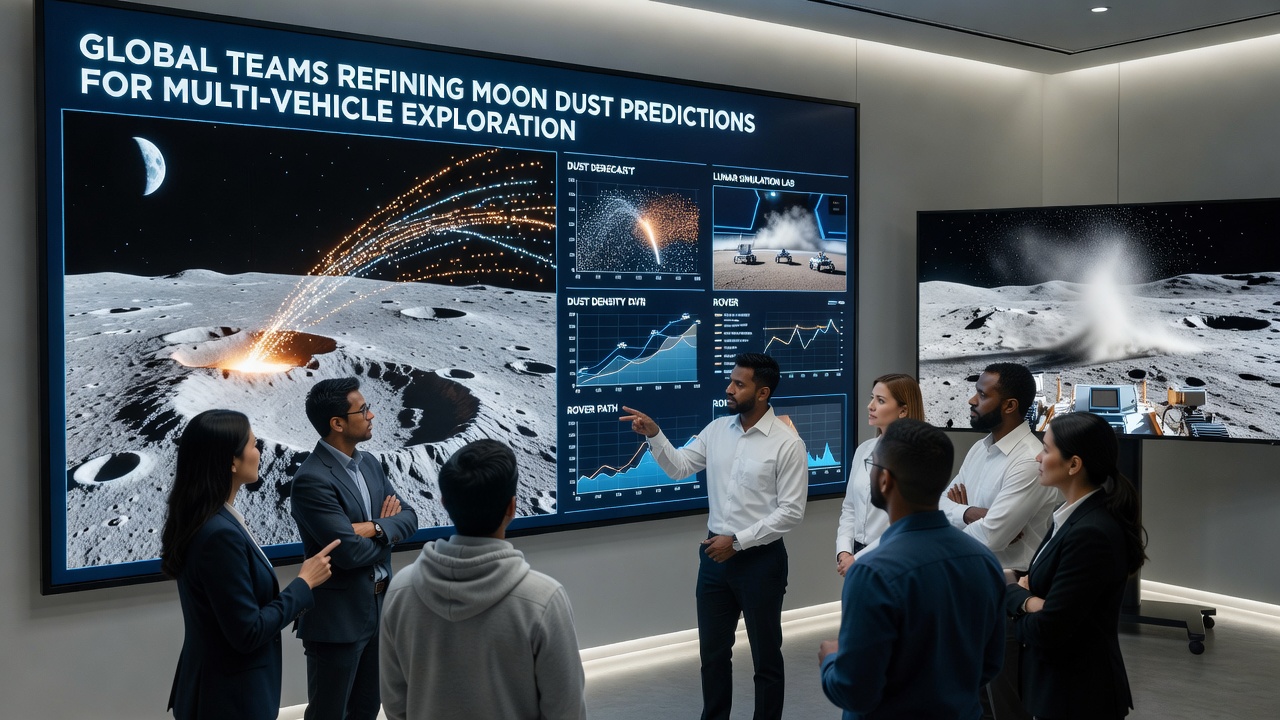
European Space Agency analysts contribute granular data on dust adhesion under varying temperatures, whereas counterparts at the Canadian Space Agency supply terrain-mapping inputs from orbital radar that refine surface roughness estimates. These combined inputs reduce uncertainty margins in long-range dust transport projections, and the resulting models support route-planning software that spaces vehicles to minimize cumulative plume interference.
Applications for Multi-Vehicle Campaigns
Fleet operations planned under the Artemis framework require synchronized movement schedules that account for overlapping dust clouds, since one vehicle's passage can alter traction conditions for following units. Updated movement predictions allow operators to sequence traverses so that high-dust zones clear before subsequent vehicles arrive, and contingency algorithms flag potential sensor degradation windows in advance.
Japanese Aerospace Exploration Agency experiments with autonomous dust mitigation coatings benefit from these refined forecasts, because accurate arrival times of particle streams help determine when protective shutters should activate. Australian researchers add hemispheric solar wind data that influences charge buildup rates, further tightening the timing windows used in joint mission planning tools.
Integration of Observational Data Streams
Orbital spectrometers and surface seismometers feed continuous streams into centralized modeling hubs, where machine-learning layers identify patterns missed by physics-based codes alone. Teams cross-reference Apollo-era samples with fresh measurements to anchor particle size distributions, and discrepancies trigger targeted re-simulation runs that incorporate the newest electrostatic constants.
Shared repositories hosted by participating agencies ensure every partner accesses identical baseline assumptions, which accelerates convergence on consensus parameters for dust lofting thresholds and settling times. These repositories also archive validation cases from analog sites in terrestrial deserts, where reduced-gravity aircraft flights provide additional calibration points.
Conclusion
Coordinated refinement of lunar dust movement predictions now supports safer and more efficient multi-vehicle exploration by supplying planners with tighter uncertainty bounds and actionable timing data. Continued fusion of international datasets promises incremental gains in model fidelity as new surface assets come online, and the resulting operational frameworks extend mission durations while protecting sensitive equipment from abrasive particle exposure.