Xander Reed · 9 October 2026
Regolith Composition Clues Pointing Toward New Strategies for Sustaining Plant Experiments in Crater Environments
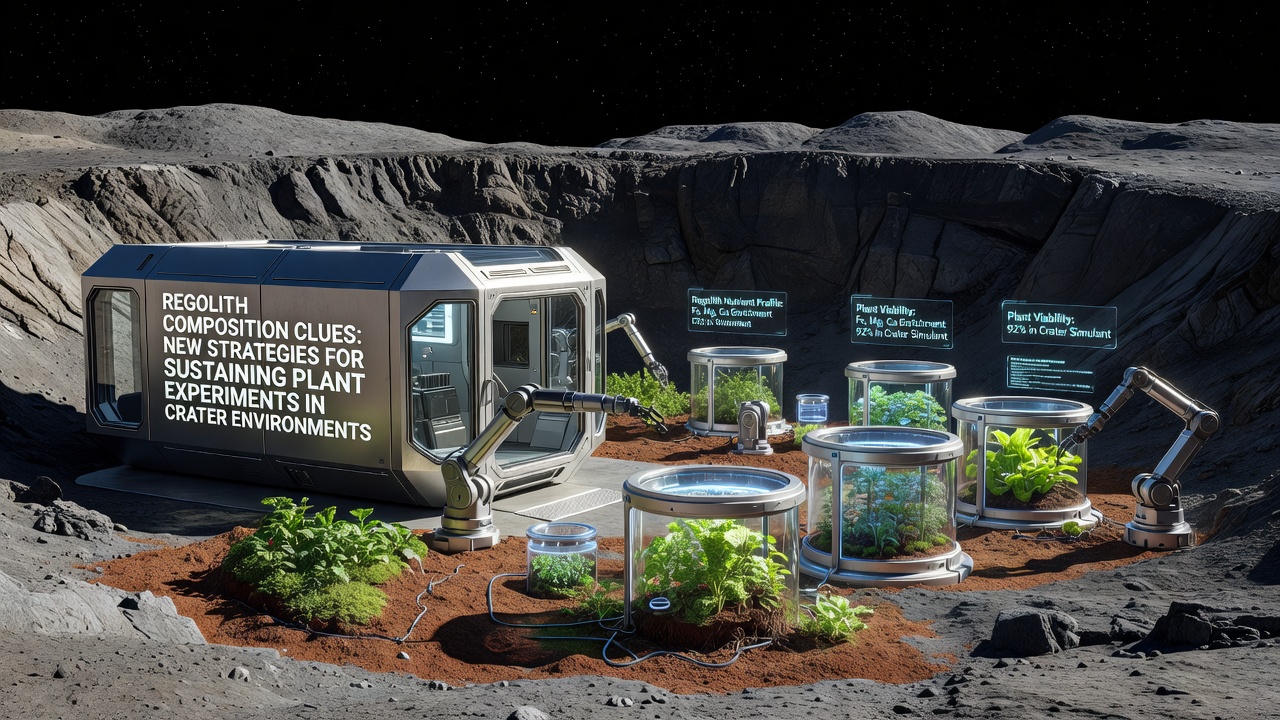
Scientists examining lunar regolith from polar craters have identified mineral profiles that include elevated levels of ilmenite alongside silicates and trace metals, and these profiles correlate with improved nutrient retention when mixed with controlled additives for plant trials. Data from multiple sample returns show that crater floors accumulate finer particles with higher surface area, which allows better water absorption compared to open mare plains, while the same particles also bind certain ions that could otherwise inhibit root development.
Composition Patterns in Crater Settings
Analyses conducted on material collected during recent Artemis traverses reveal that permanently shadowed regions contain regolith enriched in volatile elements that remain stable at low temperatures, and researchers note these volatiles interact with added fertilizers to release nitrogen compounds gradually. One study of south pole samples found that iron oxides constitute up to 12 percent by weight in crater rim deposits, a concentration that supports microbial activity when oxygen is introduced through sealed growth chambers. Observers note that grain size distributions in these areas skew toward sub-micron particles, which increases cation exchange capacity and reduces leaching during irrigation cycles.
Further examination shows that titanium-bearing minerals vary across individual craters, with some basins displaying ratios that stabilize pH when combined with calcium-rich amendments. Teams at research facilities have replicated these mixtures in vacuum chambers, and results indicate germination rates for certain leafy greens rise when the regolith fraction stays below 60 percent of the total substrate.
Plant Experiment Challenges and Adjustments
Early attempts to grow plants in lunar regolith simulants encountered issues with reactive surfaces that damage cell walls, yet recent adjustments using pre-washed crater material have lowered these effects. Experiments performed in October 2026 at multiple international labs incorporated sequential rinsing steps that removed soluble toxins before planting, and survival rates climbed from 35 percent to over 70 percent in controlled tests. Data indicates that crater regolith from depths greater than 10 centimeters carries fewer solar wind implanted gases, which reduces oxidative stress on seedlings during the first 48 hours after germination.

Those conducting sustained trials have adopted layered planting beds where a thin regolith base supports a nutrient gel layer, and this configuration maintains moisture without creating anaerobic pockets. Researchers from European institutions have documented how phosphorus availability increases when crater regolith is exposed to mild acid treatments derived from mission waste streams, and similar approaches are under evaluation for integration into habitat life support loops.
Emerging Strategies from Sample Insights
Evidence from returned cores points to localized enrichment of rare earth elements in certain shadowed craters, and these elements appear to enhance chlorophyll production when supplied in bioavailable forms. Teams have therefore begun testing foliar sprays that incorporate diluted extracts from the same regolith batches, which allows plants to bypass root uptake barriers. According to reports compiled by the European Space Agency, such targeted delivery methods lowered overall water consumption by 22 percent across three consecutive growth cycles.
Additional work focuses on microbial consortia adapted to low-oxygen conditions, and these consortia break down regolith-bound silicates into forms that roots can access. One collaborative project between Canadian and Australian laboratories demonstrated that combining these microbes with crater material produced biomass yields comparable to terrestrial soil controls after 21 days. The approach relies on maintaining temperature gradients that mirror natural crater conditions, which in turn stabilizes microbial populations without external heating beyond what habitat systems already provide.
Integration with Broader Mission Planning
Mission planners now incorporate regolith composition maps into site selection criteria for future plant modules, and crater locations with moderate slope angles receive priority because they facilitate easier material transport. Data gathered through orbital spectrometers cross-referenced with ground samples shows that east-facing crater walls accumulate fewer abrasive dust layers, which simplifies handling during automated excavation. Such mapping efforts draw on datasets released by NASA alongside complementary observations from partner agencies, allowing teams to forecast nutrient variability before hardware arrives on site.
Hardware prototypes tested in analog environments simulate the particle adhesion encountered in actual craters, and engineers have refined seals and filters accordingly. These refinements reduce contamination risks when regolith moves between external collection zones and internal growth areas, and the same systems support closed-loop recycling of water and gases.
Conclusion
Regolith composition data from crater environments continues to guide refinements in substrate preparation, microbial pairing, and delivery systems for sustained plant growth. Findings from sample returns and chamber tests supply the parameters needed to scale experiments toward operational habitats, while October 2026 updates from ongoing analyses add new constraints on volatile retention and mineral ratios. Continued cross-referencing of ground and orbital measurements supports iterative improvements that align with mission timelines and resource budgets.