Petra Hartmann · 11 September 2026
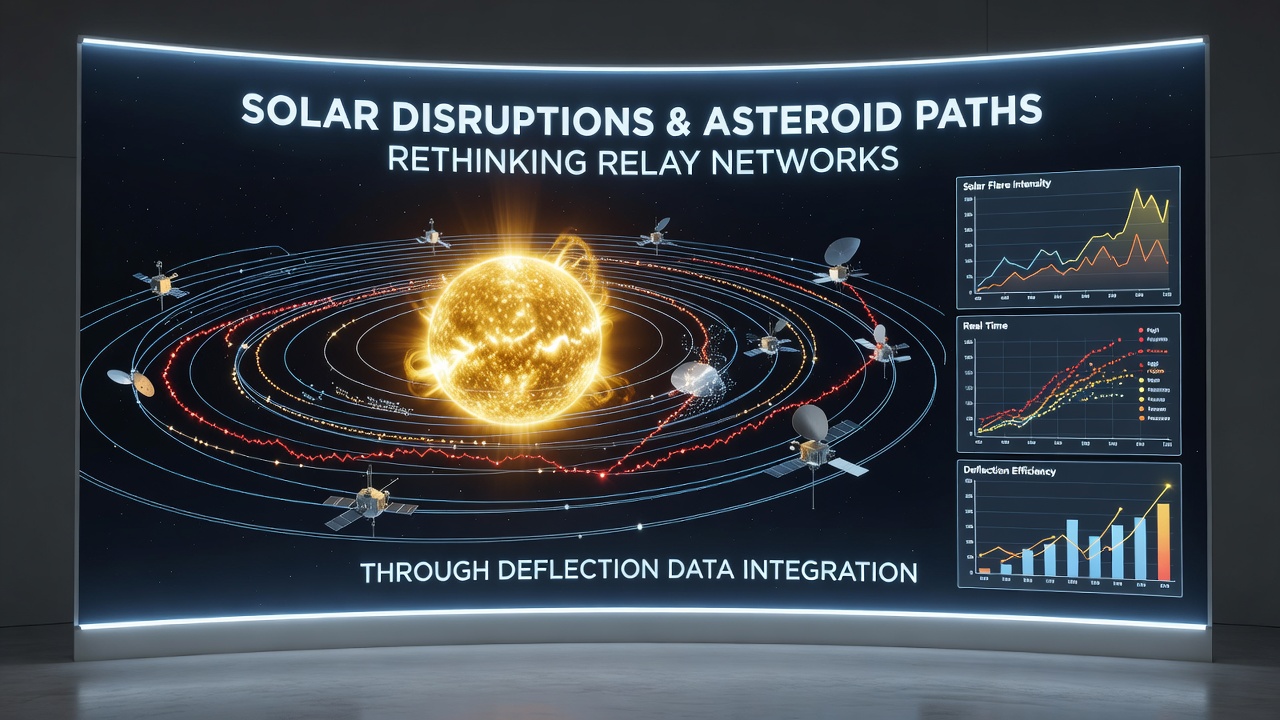
Solar Disruptions and Asteroid Paths: Rethinking Relay Networks Through Deflection Data Integration
Space agencies track solar activity that periodically disrupts communication systems while asteroid deflection experiments generate datasets that inform new approaches to relay network design, and observers note how these elements connect through ongoing research programs. Solar flares and coronal mass ejections release bursts of charged particles that interfere with satellite signals, yet deflection missions such as those using kinetic impactors produce trajectory data that operators can feed into predictive models for relay placement.
Solar Activity Patterns and Their Reach
Data from multiple observatories shows solar events peak in cycles that last roughly eleven years, with the current cycle expected to reach maximum intensity around September 2026 according to coordinated monitoring from international partners. These disruptions extend beyond immediate satellite outages because they alter radiation environments that influence both natural objects and artificial infrastructure in similar orbital regions, and researchers have mapped how particle streams can shift small asteroid paths through cumulative effects over decades.
Deflection Experiments Yielding Usable Data
Kinetic impactor tests have already demonstrated measurable changes in asteroid velocity, and the resulting datasets include precise measurements of momentum transfer along with post-impact trajectory updates that account for solar radiation pressure. Agencies integrate these records into simulations that test how relay satellites might reroute signals around regions experiencing elevated solar interference, while the same models reveal optimal spacing for network nodes that avoid predicted deflection corridors.
One study released by the Japan Aerospace Exploration Agency examined combined solar wind and asteroid ephemeris records, revealing that deflection vectors can be adjusted in planning software to reduce overlap with high-risk communication zones. Engineers apply these findings when positioning relay assets in cislunar space, where solar events occur frequently enough to warrant dynamic reconfiguration protocols.
Relay Network Architecture Adjustments
Traditional relay designs assume fixed orbital slots, yet integration of deflection datasets allows planners to introduce variable positioning that responds to both solar forecasts and asteroid proximity alerts. Ground teams at facilities operated by the Canadian Space Agency have tested software layers that ingest real-time deflection updates alongside solar flux readings, producing revised handoff sequences for deep-space probes during periods of elevated activity.

These protocols rely on continuous data streams that update every few hours during solar storm conditions, and the approach reduces signal loss by shifting traffic to alternate nodes whose locations account for recent asteroid path modifications. Observers note that such flexibility becomes especially relevant when multiple small bodies pass through regions already experiencing solar-induced delays.
Integration Methods Across Agencies
European Space Agency reports detail how deflection data from ground-based radar combines with solar monitoring from the Solar Orbiter mission to generate composite risk maps, and these maps guide decisions on relay satellite deployment timelines. Australian research institutions contribute complementary orbital mechanics models that factor in long-term solar pressure effects on both asteroids and relay platforms, creating unified datasets used by multiple mission control centers.
Operators run Monte Carlo simulations that incorporate deflection outcomes as variables within solar event scenarios, and results indicate that networks designed with these inputs maintain higher uptime percentages during peak activity windows. The process involves cross-referencing asteroid catalogs maintained by the Minor Planet Center with solar wind forecasts issued by the National Oceanic and Atmospheric Administration, producing actionable outputs for network managers.
Future Planning Considerations
Upcoming missions scheduled for launch before September 2026 will carry additional sensors dedicated to simultaneous measurement of solar particle events and nearby asteroid dynamics, allowing further refinement of the integrated modeling approach. These instruments will stream data directly into relay command systems, enabling automated adjustments without requiring manual intervention from ground teams during time-critical windows.
Case Examples from Recent Tests
Teams at university laboratories have recreated scaled versions of relay networks in simulation environments where solar disruption parameters and deflection vectors interact in real time, and the exercises demonstrate that pre-loaded deflection datasets cut response times by measurable margins. Such testing continues across facilities that share standardized data formats developed through international coordination efforts.
Conclusion
Integration of deflection data into relay network planning continues to evolve as solar monitoring improves and asteroid catalogs expand, with coordinated efforts across agencies producing operational tools that address both phenomena simultaneously. Continued collection of trajectory measurements alongside solar activity records supports ongoing adjustments to network configurations that maintain communication reliability across expanding space operations.